
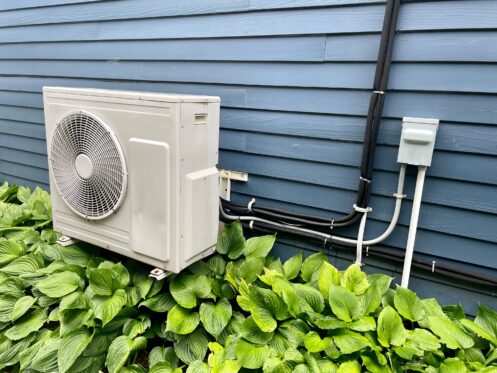
When it’s time to replace your outdated air conditioning system, you have a few different options. Two popular ones are a central air conditioner and a ductless mini-split system. Below, we’ll compare both units and discuss whether a ductless mini-split system is the better option for your household.
Central Air Conditioner Operation
Central air conditioners are one of the most popular cooling systems, as they integrate with existing ductwork for a forced-air heating system. Central air conditioners work by pulling heat out of the air inside your home and transporting it to the air outside. This requires an indoor air handler unit and an outdoor condenser unit that are connected by refrigerant lines.
You set your desired temperature on your thermostat and your central air conditioner will effectively run to cool your home down to that temperature. It will force cold air out of all the supply vents and pull in stale hot air through its return vents.
Ductless Mini-Split System Operation
Ductless mini-split systems work the same way as a central air conditioner in the sense that they extract heat from indoors and transport it outdoors. The main difference between the two is that a ductless mini-split system has multiple indoor air handler units instead of ductwork.
This allows you to set a specific temperature for each indoor air handler unit, so each room in your home can be set independently from the rest. Ductless mini-split setups can be a great option for homeowners who don’t have existing ductwork, as ducting can be really expensive to install after your home is already built.
Apart from providing adequate cooling for your home, a ductless mini-split system can also heat your home. It’s an all-in-one system that works to meet your comfort needs throughout the entire year. It’s important to note that a central air conditioner can only cool your home and won’t heat it.
Energy Efficiency
One of the most significant factors in your purchasing decision will be the operating efficiency of the unit you buy. The better the operating efficiency, the less energy your unit will use and the more money you can save on your utility bills. Central air conditioners have an efficiency rating of SEER2, known formally as a seasonal energy efficiency rating.
Most standard central air conditioners will have a SEER2 rating of around 16. However, some more expensive high-efficiency models can have a rating of up to 23. Standard ductless mini-split systems have a SEER2 rating of around 18 or more. The more expensive high-efficiency models can reach levels up to 35. It’s clear there’s a stark difference between the energy efficiency capabilities of a ductless mini-split system compared to a central air conditioner.
One other factor to consider in terms of efficiency for central air conditioners and ductless mini-split systems is ductwork losses. If you use a traditional central air conditioner, the EPA suggests you can lose up to 30% of your cold air through gaps in your existing ductwork. Because ductless mini-split systems naturally don’t use ductwork, there is no loss of treated air. This means all the cold air your system produces makes it to the rooms in your home.
When evaluating a ductless mini-split system, it can also be helpful to consider its heating efficiency. These units provide the highest efficiency system on the market today. They can reach efficiency levels of 300 to 400%, with an electric furnace being its closest competitor at 100% efficiency.
Zone Control
One fantastic advantage that mini-split systems have over central AC units is their ability to provide zone temperature control. Each indoor air handler unit can have its own temperature setting. This means you can set your bedroom slightly cooler than your living room for optimal comfort. With a traditional central air conditioner, the only way to set different temperatures in different rooms throughout your home is by purchasing an expensive zoned ductwork system.
This zone temperature control is not only great for boosting your comfort while indoors but also for lowering your energy bills. You can easily shut off units in rooms that you’re not using to conserve energy. Additionally, if you want to cool down a certain room that you’re spending a lot of time in, you don’t have to waste energy to cool down your entire home to that particular temperature.
Installation Flexibility
The indoor air handler unit for the central air conditioner gets installed next to your existing heating system. It requires an outdoor condenser unit that must sit on a flat surface outside your home to disperse the hot air. Ductless mini-split systems also need the condenser unit to function. However, when it comes to indoor unit installation, there’s a lot of flexibility.
Each indoor air handler unit can be mounted on the wall, on the floor, or your ceiling. Ceiling-mounted mini-split systems are a very discreet option, while wall-mounted units are typically the most cost-effective. The actual housing for the indoor air handler unit comes in a variety of different styles and colors to help better match your room’s interior design.
The beauty of ductless mini-split systems is that they don’t require a large amount of space as traditional ductwork does. All you need for one of these units is an exterior wall where a hole can be drilled to run the refrigerant and power lines. It’s a very small three-inch hole that sits behind the unit or in another location hidden from sight.
Tax Incentives
Whenever you purchase a new air conditioner for your home, you may be eligible to receive a tax credit under the Inflation Reduction Act of 2022. The specific amount of the tax credit will be dependent on the type of system you purchase and its efficiency rating.
Homeowners can typically recoup up to 30% of the total cost of their new system, plus installation, up to a set maximum amount. In general, central air conditioners can only qualify for up to a maximum credit of $600, while a ductless mini-split system can qualify anywhere between $2,000 to $3,200. It’s best to consult ENERGY STAR’s website to discover the specific tax credit available for the particular unit you’re thinking about purchasing.
Seek a Professional Evaluation
If you believe a ductless mini-split system is the right choice for your cooling needs, consult one of our professional HVAC technicians for an appropriate sizing recommendation. Each indoor air handler unit will likely vary from the next in sizing requirements depending on the square footage of your room, the number of windows it has, your insulation level, and so forth. Our technicians will thoroughly assess every room of your home and recommend the right sizing for each unit.
Expert Ductless Mini-Split Installation Service
Bernard Heating & Cooling provides expert ductless mini-split installation services for the Akron, OH community. We can also help with all your heating and cooling repair, replacement, and maintenance needs. Call our office today to book your next service appointment with one of our experienced HVAC technicians.